 0411 752 873
  info@vicmetalroofing.com.au

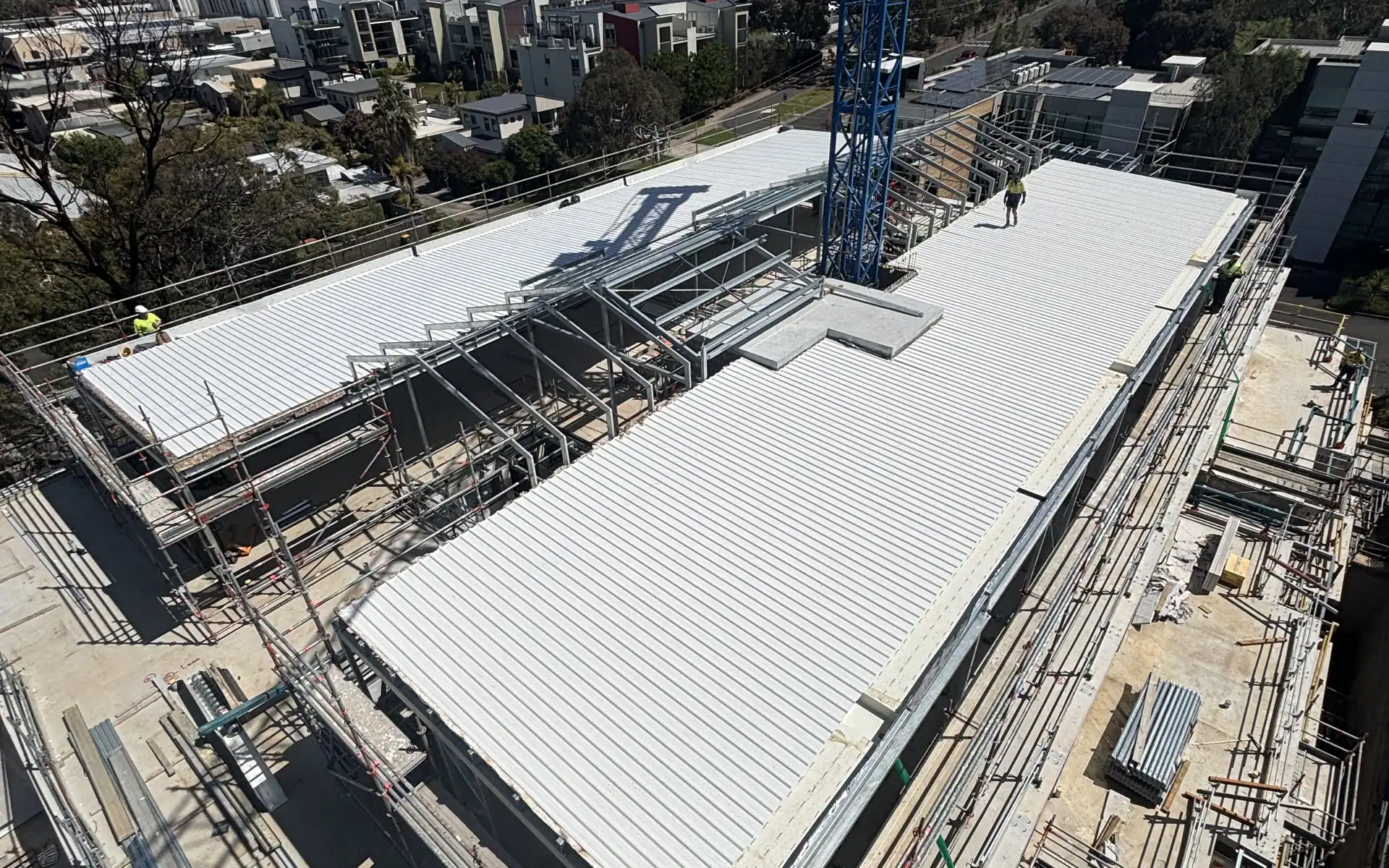
Your warehouse roof is one of the largest and most exposed assets on your balance sheet. When it performs, you do not think about it. When it fails - a leak over a racking system, water pooling on a concrete floor, damaged stock, or a WorkSafe incident - the cost goes well beyond the repair bill.
As a facility manager or asset owner, your job is to keep the building performing, protect what is inside it, and manage capital expenditure in a way that makes sense over the long term. That means understanding your roof well enough to make good decisions - when to maintain, when to repair, when to replace, and what to specify when you do.
This guide covers everything you need to know about warehouse roofing in Melbourne from that perspective. No technical jargon. Just the practical information that helps you manage your asset properly.
What Makes Warehouse Roofing Different
Warehouse roofs are not simply large residential roofs. They present a specific set of conditions that affect how they are specified, installed, and maintained.
- Scale means compounding consequences. A minor issue on a 200m² residential roof is contained. The same issue on a 3,000m² warehouse roof - a failing sealant, a corroding box gutter joint, a skylight flashing that has dried out - can affect a large area before it is detected. Regular inspection is the only way to catch these issues while they are still minor.
- Low pitch creates drainage risk. Most warehouse roofs sit between 1 and 5 degrees pitch. Water moves slowly at these angles. Debris accumulates in gutters faster. Ponding is more likely. Every element of the drainage system needs to be correctly designed, correctly installed, and regularly maintained to perform.
- The roof affects your operating costs. A poorly performing roof that absorbs heat drives up air conditioning and refrigeration costs. A roof with ageing insulation or a dark colour specification in a facility with temperature-sensitive operations or a large workforce is not just a building issue - it is an operational cost issue that compounds every year.
- Compliance sits with you. If your building was constructed before 1990 and has not been re-roofed, there is a strong chance the roof contains asbestos cement sheeting. Under Victoria’s OHS Regulations 2017, you as the person who manages or controls the workplace have legal obligations around asbestos management - not just the contractor you engage. This is not something to manage informally.
Knowing Where Your Roof Is in Its Life Cycle
The single most useful thing a facility manager can do is understand the current condition and approximate remaining service life of the roof. Without this, maintenance budgets are guesswork and capital planning is reactive.
A professional roof inspection - not a walk-around by a handyman but a documented assessment by an experienced commercial roofing contractor - will tell you:
This gives you something actionable - a written condition report you can use to plan maintenance budgets, support capital expenditure requests, and make a properly informed decision about whether to maintain, repair, or replace.
Our commercial roof maintenance service provides exactly this, with a written report after every inspection.
- The condition of the sheeting, including corrosion, paint failure, and physical damage
- The condition of fasteners - are they holding, corroding, or pulling through the sheet?
- The condition of all flashings, ridges, cappings, and penetration seals
- The condition of box gutters, eave gutters, and downpipes
- Whether any areas show signs of ponding or inadequate drainage
- Whether skylights are cracking, yellowing, or showing flashing deterioration
- An honest assessment of remaining service life and recommended action
The Maintain, Repair, or Replace Decision
This is the question facility managers and asset owners face most often, and the answer is almost always determined by the condition of the roof rather than its age.
The key mistake asset owners make is continuing to spend on maintenance and repair on a roof that has clearly reached end of life. If you are spending significant money on your roof every year and the problems keep coming back, a replacement conversation is worth having.
Our commercial re-roofing service is designed specifically for this scenario, and we manage the project to maintain operational continuity during works wherever possible.
- Keep maintaining when the roof is structurally sound, the sheeting has meaningful life left, and the issues presenting are isolated - a failed sealant, a blocked gutter, a loose fastener. A structured annual maintenance program keeps these issues managed and prevents them from developing into something more serious.
- Repair when there is a defined failure - a leaking flashing, a damaged sheet section, a box gutter joint that has failed - but the rest of the roof is in acceptable condition. A targeted repair addresses the specific failure without the cost and disruption of full replacement.
- Replace when the roof has reached the end of its serviceable life across a significant portion of its area. The indicators are widespread corrosion or paint failure, persistent leaks that cannot be resolved through repair, fasteners that are consistently failing, and box gutters that are deteriorating at multiple points. At this stage, the annual cost of keeping the roof watertight through ongoing repairs will exceed the cost of replacement within a few years. Replacement also delivers a new warranty, improved thermal performance, and the elimination of the ongoing maintenance liability.
If Your Building Was Built Before 1990: Asbestos
This section matters for a significant number of facility managers and asset owners in Victoria. Asbestos cement roofing - commonly known as fibro or Super Six - was the dominant commercial and industrial roofing material before it was phased out in the late 1980s. Many warehouses and factories built during this period still have their original roofing in place.
Your obligations as the person managing or controlling the workplace are clear under the OHS Regulations 2017:
You must maintain an asbestos register for the premises. If one does not exist and your building pre-dates 1990, commissioning one is your first obligation. Any contractor working on the building must be given access to the register before they start work. If the asbestos is deteriorating - sheets that are cracking, crumbling, or becoming friable - you have an obligation to act.
Removal must be carried out by a WorkSafe Victoria licensed asbestos removalist. The process includes a formal asbestos control plan, mandatory WorkSafe notification at least five business days before work commences, EPA-licensed disposal of all removed material, and an independent hygienist clearance certificate before the site can be reoccupied or re-roofed.
The practical reality for most facility managers in this situation is that asbestos roof removal and new roof installation should be managed as a single coordinated project rather than two separate engagements. We hold a current asbestos removal licence and manage both phases under one contract - removing the scheduling complexity, reducing total cost, and giving you a single point of accountability for the entire project.
You can read the full process, regulatory requirements on our commercial asbestos roof removal page.
Material and Profile: What Goes on the Roof
You do not need to be a materials expert to manage a roof effectively, but understanding the basic options helps you have an informed conversation with your contractor and evaluate what is being quoted.
Colorbond steel is the standard specification for warehouse and industrial roofing in Melbourne. It is a pre-painted zinc-aluminium alloy coated steel manufactured by BlueScope, engineered specifically for Australian conditions, and backed by a manufacturer’s warranty on both the steel and the paint system. It comes in a wide colour range and multiple product grades for different environments.
For large warehouse roofs where energy performance is a genuine operational concern,
Colorbond Coolmax is worth specifying. Its coating technology reflects more solar infrared radiation than standard Colorbond in the same colour, which translates to lower internal temperatures, reduced cooling loads, and lower energy costs - particularly relevant for facilities running refrigeration or large workforces in summer.
For coastal locations within 1km of a surf beach or tidal estuary, Colorbond Ultra is the correct specification. Standard Colorbond is not rated for these environments.
Zincalume steel is the unpainted metallic substrate beneath Colorbond’s paint system, used as a finished product in its own right. It costs less per sheet than Colorbond and suits industrial applications where appearance is not a consideration. For a detailed comparison, see our article on Colorbond vs Zincalume for commercial projects.
On profile, the two most commonly specified options for warehouse roofing are Trimdek - a trapezoidal rib profile with excellent spanning capacity and suitability for pitches as low as 1 degree - and Klip-Lok, a concealed-fix profile with no fasteners penetrating the sheet face, delivering superior watertightness and wind-uplift performance. Klip-Lok is the preferred specification on larger industrial facilities and any project where watertightness is a non-negotiable requirement.
Drainage: The Detail That Determines Long-Term Performance
Poor drainage is the most common cause of premature roof failure on warehouse buildings. It is also the most preventable.
Box gutters - the internal valleys on multi-span warehouse roofs - collect water from two roof faces and channel it to downpipes. When they are correctly designed, correctly graded, and regularly maintained, they perform without issue. When they are undersized, incorrectly graded, or blocked with debris, they back up and overflow through internal flashings and penetrations. The resulting leaks are often difficult to trace and expensive to repair.
As a facility manager, box gutter condition and cleanliness should be on your regular maintenance checklist. Annual inspection and cleaning is the minimum. In environments with significant leaf fall or industrial dust, twice-yearly is more appropriate.
Overflow relief - a designed escape path for water when the primary drainage system is overwhelmed - should be part of the original design and should be checked as part of every inspection.
Downpipe sizing should be verified against the roof area and Melbourne’s rainfall intensity data. Undersized downpipes are a common legacy issue on older warehouse buildings.
Operational Continuity During Roofing Works
A re-roofing or major maintenance project on a working warehouse is a significant operational event. Managing it well requires planning from both sides - your operations team and your roofing contractor.
Key considerations from your side include identifying which areas of the warehouse floor are most sensitive to disruption or exposure during works, whether any scheduled shutdowns or low-activity periods can be aligned with the most disruptive phases, what restrictions apply to access for scaffolding, material deliveries, and waste removal, and whether any special precautions are required for the goods or processes below.
A professional commercial roofing contractor will plan the project in stages, establish clear exclusion zones on the warehouse floor below active works, and communicate schedule changes promptly. They will not start work on a section of roof they cannot complete and make watertight before the end of the working day.
Ask your contractor specifically how they plan to manage operational continuity before you sign the contract. If they cannot give you a clear answer, that is a meaningful signal.
Structuring Your Maintenance Budget
From a capital planning perspective, warehouse roof maintenance and replacement should be treated as a known, scheduled cost rather than a reactive expense.
A roof that is well maintained will typically provide 25 to 40 years of serviceable life depending on the material, the environment, and the quality of the original installation. A roof that receives no maintenance will fail significantly earlier and often at a much higher total cost.
A practical approach for asset owners is to treat roof maintenance as an annual line item, budget for a professional inspection and maintenance visit every year, and maintain a condition report file that documents the roof’s status over time. When it comes time to plan a capital replacement - whether as part of a refinancing event, a property sale, or a scheduled asset upgrade - that documented history is genuinely valuable.
If you do not currently have an annual maintenance program in place for your warehouse roof, our commercial roof maintenance service is a straightforward way to establish one. We service warehouses and industrial facilities across Melbourne and regional Victoria, and provide a written report after every inspection.
Working With a Roofing Contractor: What to Expect
Engaging a commercial roofing contractor for an inspection, maintenance program, or replacement project should be a straightforward process. At VIC Metal Roofing, our process for every project is the same regardless of scale.
We start with a site inspection at no cost and no obligation. We assess the roof, discuss your requirements and constraints, and provide a written, itemised quote that specifies all materials by product and grade with no vague line items or lump sums. Once you accept the quote, we formalise the agreement in a fixed-price contract. The price does not change unless the scope changes, and any scope changes are agreed in writing before additional work proceeds.
Throughout the project, you have a single point of contact - Ben or Alex directly - not a call centre or a rotating cast of project coordinators. You hear about issues promptly, not after the fact.
You can read the full process on our How We Work page.
Ready to Talk About Your Warehouse Roof?
Whether you need an inspection and condition report, an annual maintenance program, a re-roofing quote, or advice on managing an asbestos roof on an older facility, VIC Metal Roofing works with facility managers and asset owners across Melbourne and regional Victoria.


